Medical News Today recently covered the challenge of sustaining astronaut nutrition during crewed missions to Mars. The report emphasizes that feeding a small crew on a journey that could last months to years requires solutions that protect health, performance, and morale under tight logistical constraints.
In its overview, Medical News Today highlighted recurring themes in planning for Mars missions: limited opportunities for resupply, the need for long shelf life and nutrient stability, physiological changes that affect nutrient needs and appetite, and interest in producing fresh food in transit or on the surface.
Context
Long-duration deep space missions raise nutritional questions that differ from short Earth-orbit flights. On missions beyond low Earth orbit, crews cannot rely on frequent resupply, and they face prolonged exposure to microgravity and radiation. Nutrition is central not only to preventing deficiency, but also to maintaining muscle and bone, supporting immune function, preserving cognitive performance, and providing psychological comfort through food variety.
Evidence
Experience aboard the International Space Station and results from terrestrial analogs inform planning for Mars. Those operational settings have shown that packaged and shelf-stable meals have been essential, while fresh food and variety have clear benefits for crew wellbeing. Research programs also monitor how microgravity and other spaceflight stressors change taste perception, appetite, and nutrient absorption, which in turn can influence menu design and supplementation strategies.
Why this matters
Nutrition directly affects an astronaut’s ability to perform demanding tasks, recover from illness or injury, and cope with the psychological strains of isolation. On a Mars mission, a nutritional failure could compromise mission objectives or crew safety because help and resupply would be limited or delayed.
Limitations
Much of what is known comes from missions in low Earth orbit, ground-based simulations, and early-stage research. Those environments cannot fully replicate the combined challenges of a multi-year trip to Mars, including higher radiation levels and prolonged microgravity exposure. As a result, strategies that look promising now will need further testing before they can be relied on for crewed Mars missions.
What to keep in mind
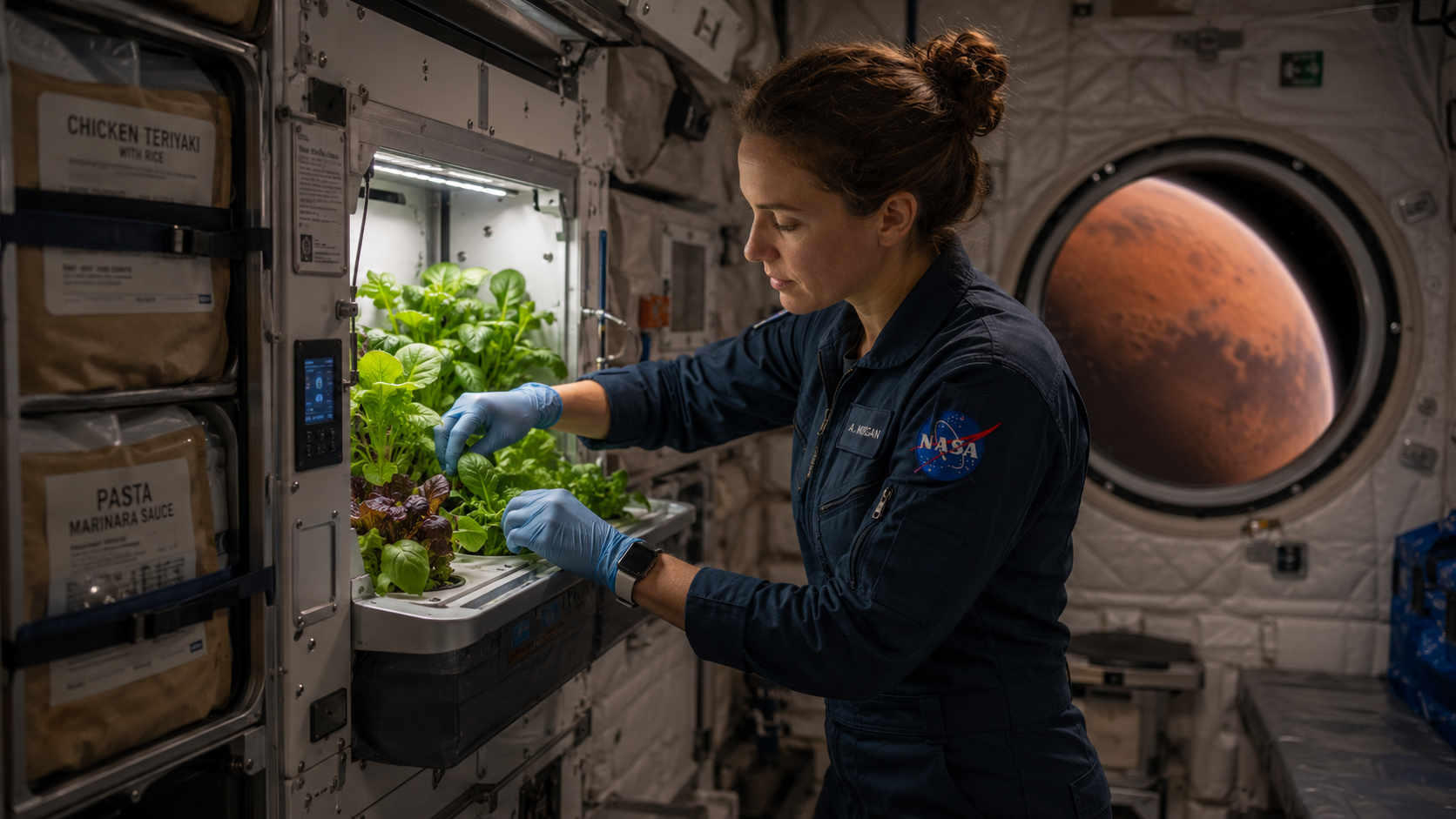
There is no single fix. Mission planners are likely to use a mix of approaches: highly stable, nutrient-dense packaged foods; controlled on-board production of fresh vegetables where feasible; monitoring and adjusting individual nutrient intake; and menu design that supports appetite and morale. Technological advances on Earth in food preservation, vertical farming, and closed-loop life support may speed progress, and many of these innovations could also help with terrestrial food security.
The bottom line
Feeding astronauts on a Mars mission is a solvable but complex challenge. Ongoing research, careful operational testing, and incremental technology development will be needed to move from concept to reliable practice. For the public, advances in this area are likely to yield Earth-side benefits in sustainable food systems and preservation methods.
Medical caution: this article summarizes high-level planning issues. Individuals should consult a qualified health professional before making medical or nutritional decisions.